Ralev
Standards & Methodology — Documented Practice

HOW THE WORK IS BUILT.

The standards that govern Ralev's practice are neither incidental nor aspirational — they are procedural. Each coaching engagement follows a documented sequence: from initial screening through programme design, session delivery, and progress review. The sequence does not vary.

Accreditation
Certified Personal Trainer — REPs Level 3
Practice Standard
Evidence-Informed · Periodised · Documented
Insurance
Public Liability · Professional Indemnity
01 — The Coaching Sequence

A six-stage process, applied to every engagement

01

Initial Consultation

A structured conversation held in the studio or by video. The purpose is to understand the individual's movement history, current activity level, occupational demands, and specific objectives. Notes from this session form the basis of the movement screening protocol.

Duration: 45 min
02

Movement Screening

A structured physical assessment covering fundamental movement patterns: squat, hinge, push, pull, carry, and rotation. Observations are recorded against a standardised checklist. The screening identifies both capacity and restriction — informing which exercises are appropriate from the first session onward.

Duration: 60 min
03

Programme Design

A periodised training plan is assembled from the screening outcomes and stated objectives. The plan specifies weekly schedule, session structure, exercise selection, loading parameters, and progression logic. It is reviewed with the individual before the first working session begins.

Delivered in writing
04

Session Delivery

Each session follows the designed structure while accommodating the individual's readiness on the day. Load and volume adjustments are made in real time and recorded in the training log. Coaching cues are drawn from the movement screening findings and updated as technique develops.

Logged each session
05

Progress Check-In

At the midpoint of each programme block — typically weeks four or five — a structured check-in reviews the training log, reassesses movement quality against the screening baseline, and determines whether loading progressions are on track. The outcome of this review is documented and shared.

Written summary provided
06

Block Review & Continuation

At the close of each programme block, outcomes are assessed against the objectives set in the initial consultation. A new block is designed based on what was achieved, what shifted, and what the individual's priorities are for the next period. Continuation is the standard expectation; it is not assumed.

New plan issued
02 — Professional Standards

Accredited practice, ongoing professional development

Ralev holds a Level 3 Certificate in Personal Training registered with the Register of Exercise Professionals (REPs), the European standard for qualified fitness practitioners. The accreditation is maintained through a structured continuing professional development programme that includes biomechanics refreshers, updated strength and conditioning literature, and periodic peer review sessions with other registered practitioners.

Professional indemnity and public liability insurance is held and renewed annually. Certificates are available on request at the studio. All client data is held in accordance with the applicable data protection framework — see the Privacy Policy for specifics.

Where a coaching engagement falls outside the scope of personal training — for instance, where an individual's situation requires input from a qualified nutrition professional or a physiotherapist — referrals are made clearly and without delay. Ralev does not extend its practice beyond its accredited scope.

REPs Level 3 Certified
Register of Exercise Professionals — the European benchmark for qualified personal trainers. Annual renewal with verified CPD hours.
Insured Practice
Public liability and professional indemnity cover in place for all sessions — in-studio, outdoor, and remote programme support.
Evidence-Informed Programming
Programme design references current published research in strength and conditioning. No proprietary systems, no unsupported protocols.
Ongoing Professional Development
Structured CPD programme covering biomechanics, movement science, and updated conditioning literature — minimum 20 hours per year.
03 — Programme Design Principles

The logic behind every programme written at Ralev

Periodisation as the frame

All strength and conditioning programmes at Ralev are periodised — meaning they are divided into distinct blocks with different loading emphases. A typical annual structure moves through accumulation (volume-focused), intensification (load-focused), and realisation (performance expression) phases, with deliberate deload weeks built into each block.

For individuals who do not have an annual competition calendar, periodisation serves a different but equally important purpose: it prevents adaptation plateaus, manages accumulated fatigue, and creates a coherent narrative for progress that the training log can track objectively.

Movement quality as the floor

Loading is never increased at the expense of movement quality. The screening baseline establishes the standard for each fundamental pattern; sessions are designed to build capacity within that standard before adding external load. Where technique deteriorates under a given load, the load is reduced — not the standard.

This is not a philosophical position. It is a practical one: the cost of rebuilding compromised movement patterns is higher than the cost of progressing more slowly through a well-executed standard. The training log records both load and quality observations, so the relationship between the two can be reviewed over time.

Active recovery as part of the plan

Rest days and active recovery sessions are planned elements of every programme — not gaps in a schedule. Active recovery work typically involves low-intensity movement, mobility work, or flexibility sessions that support the adaptation process between higher-intensity sessions.

Individuals are coached in how to use rest-day routines effectively. The objective is to arrive at each session with appropriate readiness — neither under-recovered nor stiff from prolonged inactivity.

Nutrition guidance within scope

Practical guidance on balanced meal structure, portion awareness, pre-workout fuel, and post-workout recovery meals is offered as a component of lifestyle coaching. This guidance is framed around everyday habits rather than precise calculations, and remains within the scope of a qualified personal trainer rather than a registered nutritionist.

Where detailed nutritional assessment is indicated — for instance, in cases of specific dietary requirements — a referral to a qualified nutrition professional is recommended. Ralev is an independent wellness resource focused on everyday movement and active lifestyle practices.


04 — Documentation

The training log as the primary record

Every session at Ralev produces a written record: exercises performed, sets and repetitions completed, loading used, and any notable observations about form or readiness. This record accumulates across a programme block and becomes the evidence base for progress check-ins and block reviews.

The training log is shared with each individual after every session. It is not an internal document — it belongs as much to the person being coached as to the coach. The ability to review one's own progress independently is a stated goal of the documentation practice.

Session notes, goal-setting records, and body composition assessments are held for the duration of the coaching engagement and for twelve months thereafter, in accordance with Ralev's data retention framework.

Open training log notebook on a wooden desk in a coaching studio, handwritten session notes showing sets, reps, and load progressions over four weeks
Coach reviewing a printed periodised programme document at a standing desk, Brussels studio interior visible in background with clean white walls and equipment racks
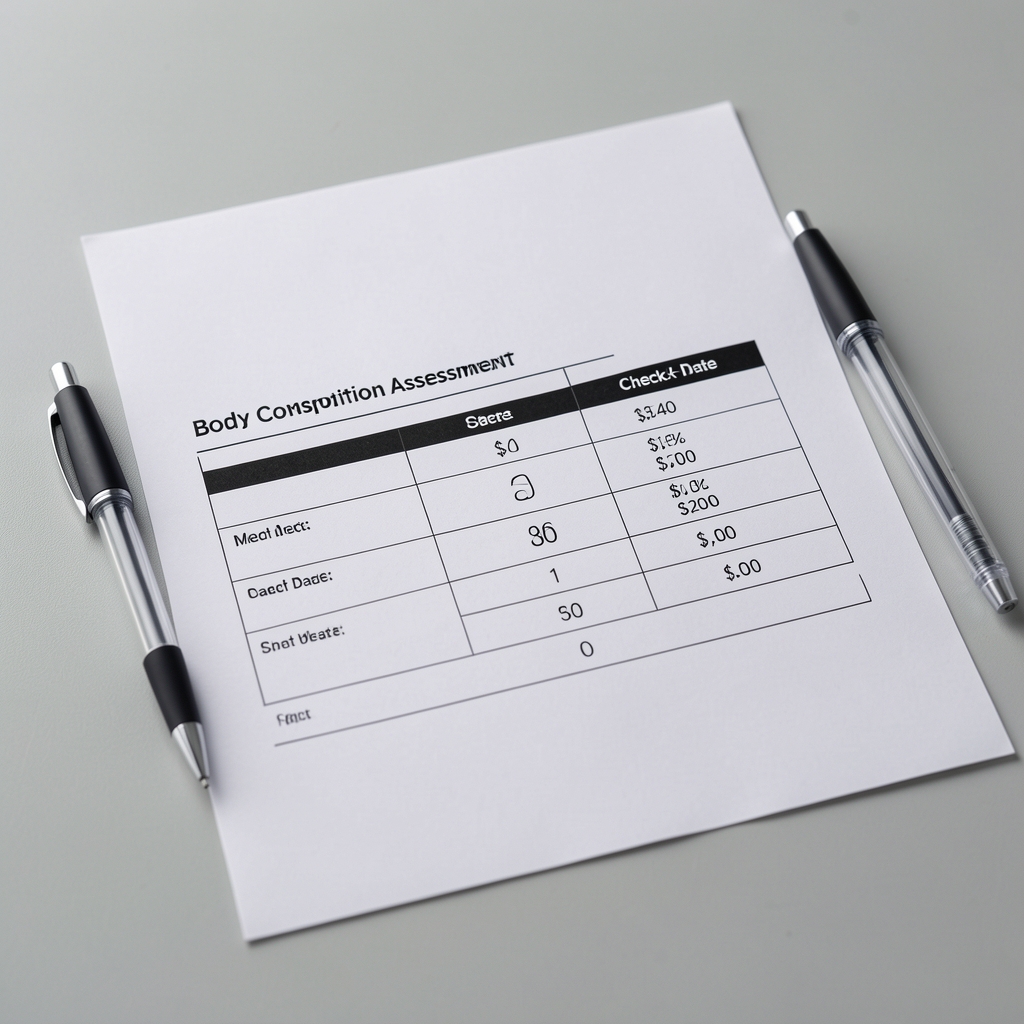
Close-up of a body composition assessment form with measurement data recorded across three check-in dates, pen resting beside the document on a light grey surface
Two people in a Brussels personal training studio, one standing coach and one seated individual, reviewing a progress summary document together at a small table
05 — Scope of Practice

What the practice covers, and what it does not

Within scope
  • Movement screening and functional fitness assessment across the primary movement patterns
  • Periodised strength programming, endurance block design, and sport-specific conditioning
  • Flexibility training, mobility work, and posture correction within a functional fitness context
  • Body composition assessment using standardised measurement protocols with documented baselines
  • Goal-setting frameworks, progress tracking, and training log documentation across all programme formats
  • General nutrition guidance on balanced meal structure, hydration habits, and active recovery meals — within the scope of a certified personal trainer
  • Lifestyle coaching covering sleep quality, stress management practices, and outdoor training integration
Outside scope — referred
  • Detailed nutritional assessment, structured meal plans, or management of specific dietary requirements — referred to a registered nutritionist
  • Rehabilitation following injury or invasive procedure — referred to a qualified physiotherapist
  • Mental health support or psychological coaching — referred to an appropriate qualified professional
  • Any area requiring a qualified wellness professional's input beyond the scope of REPs Level 3 certification
Ralev — Practice Statement

Ralev is an independent wellness resource focused on everyday movement and active lifestyle practices. The content and coaching provided are not affiliated with any governmental or institutional body. We recommend speaking with a qualified wellness or nutrition professional before introducing significant changes to your routine, particularly if you have specific dietary requirements.
06 — Questions on the Process

How the methodology works in practice

Begin the Process

Start with a movement screening in Brussels